On a stretch of French coastline barely 50 miles long, the fate of an entire civilization was decided in a single blood-soaked dawn. Normandy's beaches carry the weight of the world's most consequential military operation — and a profound, living legacy that continues to draw millions every year.
Long before the roar of landing craft engines, Normandy's coastline was shaped by forces both geological and human. The region's chalk cliffs and sandy beaches were formed over millions of years as the English Channel carved itself from the land bridge connecting Britain to continental Europe. Celtic tribes, known as the Lexovii and Caletes, settled these shores centuries before the Roman conquest of Gaul in 56 BC. Julius Caesar himself documented the strategic value of this coastline, and Roman settlements flourished along the Seine estuary. The sea was both provider and highway, sustaining fishing communities whose descendants would still walk these same beaches two thousand years later.
The region took its enduring name from the Norse warriors who ravaged and then settled its shores. In 911 AD, the Frankish king Charles the Simple ceded the territory to Viking chieftain Rollo in the Treaty of Saint-Clair-sur-Epte, giving birth to the Duchy of Normandy. These seafaring Norsemen — Normans — transformed the coastline, building harbors and fortifications that shaped the region's character for centuries. Their most famous export was conquest itself: in 1066, Duke William of Normandy sailed from these very shores to claim the English throne at the Battle of Hastings, forever altering the course of European history from a beach that had already grown accustomed to changing the world.
For much of the medieval and early modern period, Normandy's coastal villages thrived on fishing and trade across the Channel. Communities like Grandcamp-Maisy, Vierville-sur-Mer, and Colleville-sur-Mer were modest but prosperous, their economies tied to the rhythms of the tides and the herring seasons. The Hundred Years' War between England and France periodically brought violence to these shores, and the coastline changed hands multiple times between the 14th and 15th centuries. The famous Mont-Saint-Michel, rising dramatically from the tidal flats just west of the invasion beaches, became both a symbol of Norman spiritual identity and a fortress that repelled English siege after siege during this long and brutal conflict.
By the 18th century, the Norman coast had developed a dual identity as both a working maritime landscape and an emerging destination for wealthy travelers seeking sea air and scenic cliffs. The Romantic movement brought artists and writers to Normandy's dramatic headlands; painters like Gustave Courbet and later Claude Monet, who famously captured the Étretat cliffs in dozens of canvases, transformed the region's image in the European imagination. Fashionable resorts grew at Deauville and Trouville, where Parisian high society arrived by train to promenade along boardwalks and bathe in the surf. This genteel tourism stood in quiet contrast to the ancient fishing villages just miles to the west, where life remained stubbornly tied to the sea.
The First World War cast a long shadow over Normandy, though the front lines lay far to the east. Coastal towns hosted soldiers in transit, and the ports shipped men and materiel across the Channel in vast quantities. The region emerged from that war relatively intact but economically strained, setting the stage for the quiet rural life that American and British paratroopers would encounter descending through darkness on the night of June 5, 1944. Farmers, fishermen, and their families — many of whom had lived under German occupation since June 1940 — awoke to the sound of distant thunder that was not thunder, and understood instinctively that their long wait was finally, terrifyingly over.
In the immediate aftermath of liberation, the people of Normandy began the painful work of rebuilding towns that had been reduced to rubble — not only by German forces but by the Allied bombing campaigns that preceded the landings. The city of Caen lost roughly 75 percent of its buildings. Yet even as reconstruction began, the impulse to memorialize was equally powerful. The first modest monuments appeared within months of liberation, erected by grateful communities and surviving veterans who understood that what had happened here must never be forgotten. The Normandy American Cemetery at Colleville-sur-Mer was established in 1944 and formally dedicated in 1956, its 172.5 acres of manicured grounds and 9,387 white marble crosses and Stars of David becoming the defining image of American sacrifice in Europe.
The 1960s and 1970s saw the systematic development of what historians now call the Memorial Trail — a network of museums, monuments, and preserved sites stretching the length of the D-Day coastline. The Mémorial de Caen, opened in 1988 to mark the 44th anniversary of D-Day, set a new standard for immersive historical interpretation and quickly became one of France's most visited museums. At Utah Beach, Omaha Beach, and Pointe du Hoc — where US Army Rangers scaled 100-foot cliffs under fire — original German fortifications were preserved as open-air monuments. Battery Longues-sur-Mer still has its intact naval guns pointing seaward, an eerie and eloquent reminder of what the Allied soldiers faced across the water.
The anniversary commemorations held every five and ten years have drawn world leaders and veterans in scenes of remarkable emotional power. The 40th anniversary in 1984 featured President Ronald Reagan's celebrated 'Boys of Pointe du Hoc' speech, widely regarded as one of the greatest addresses of the 20th century. The 50th anniversary in 1994 brought together surviving veterans in enormous numbers for what many recognized would be among the last large-scale gatherings of the men who had fought there. By the time of the 75th anniversary in 2019, with only a handful of veterans still living, the torch of memory had visibly passed to a new generation — visitors, educators, and storytellers committed to keeping the story alive.
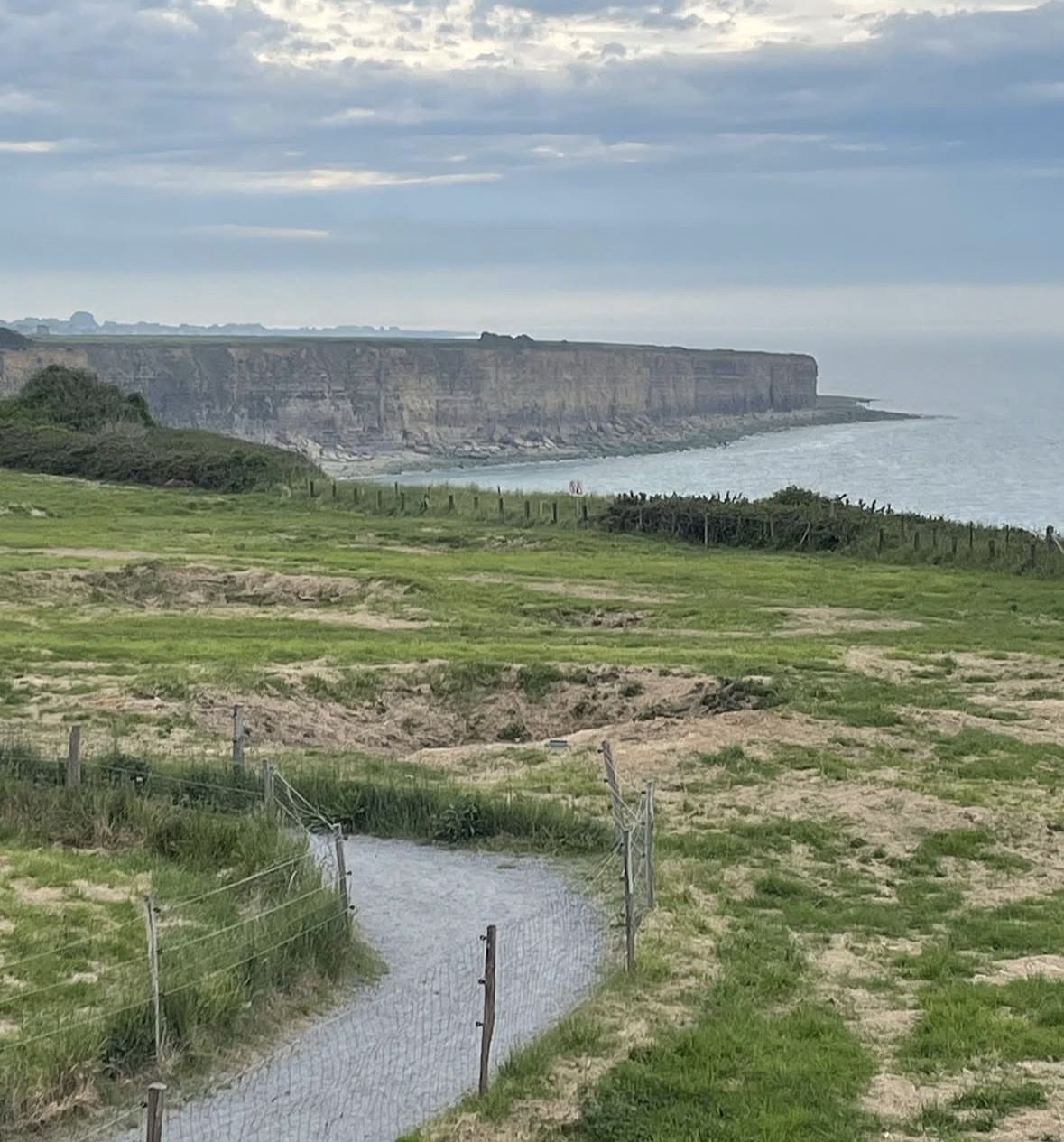
Today, more than four million visitors travel to the Normandy beaches each year, making the region one of Europe's premier heritage destinations. The five landing beaches — Utah, Omaha, Gold, Juno, and Sword — each offer distinct experiences, from the vast, wind-swept expanse of Omaha to the intimate Canadian memorials at Juno. The landscape itself retains a powerful authenticity: original bunkers still jut from clifftops, craters pock the turf at Pointe du Hoc, and the rusting remnants of the Mulberry artificial harbors still protrude from the sea at Arromanches, where the prefabricated British port was assembled in just twelve days after D-Day to supply the invasion forces.
Beyond the memorials, Normandy rewards visitors with extraordinary natural beauty, world-class cuisine, and a warmth that feels inseparable from the region's history. Local producers still make the cider and Calvados that American soldiers tasted for the first time in liberated farmhouses, and the markets of Bayeux — whose medieval tapestry chronicles the Norman conquest of 1066 — overflow with regional cheeses and fresh seafood. Whether you come to pay your respects at the cemetery, to understand the mechanics of the greatest military operation ever attempted, or simply to stand at the water's edge and feel the weight of history beneath your feet, Normandy's beaches offer an experience that is impossible to replicate anywhere else on earth.
Ready to Experience It Yourself?
There is no substitute for standing on the sand at Omaha Beach, looking out at the Channel and understanding — in your bones — what happened here. Expert-guided tours of the D-Day beaches bring the history to vivid life with access to sites, stories, and insights you simply cannot find on your own. Book your Normandy experience today and carry this story home with you forever.
Book Your Tour Now